
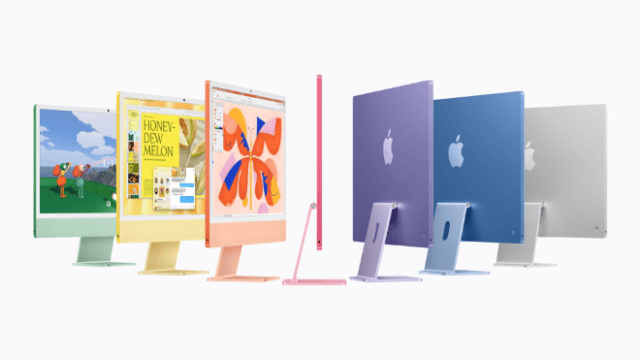
In a detailed hands-on evaluation published this week, Ars Technica’s Andrew Cunningham finds that Apple’s new M6 iMac delivers exactly what longtime iMac buyers expect: a colorful, cable-minimizing all-in-one that stays current with Apple’s latest silicon without reinventing its form. The machine keeps the same thin, screen-on-a-stand design introduced years ago, complete with a 24-inch IPS LCD panel at 4480 × 2520 resolution and a thick white bezel. It arrives in six vibrant color tints plus silver, with matching finishes on the front, back, stand, keyboard, mouse, trackpad, and cables. Ports remain limited — two or four Thunderbolt 4 ports depending on configuration, plus a side headphone jack — with optional 2.5-gigabit Ethernet relocated to the power brick so wiring stays hidden. A VESA mount adapter is available at no extra cost for those who prefer wall or arm mounting. Pricing starts at $1,499 for the base model, which uses a cut-down M6 chip (10 CPU cores and 10 GPU cores), tops out at 24 GB of RAM and 1 TB of storage, and ships without Touch ID on the keyboard. The $1,699 configuration unlocks the full 12-core CPU/GPU M6, higher RAM and storage ceilings (32 GB and 2 TB), four Thunderbolt ports, and Touch ID on both keyboard options. Compared with an M4 iMac at launch, the M6 carries a $200 premium. Cunningham notes that a similarly specified Mac mini costs roughly $800 less, though the iMac’s integrated display and simplified setup remain the main draws for users who want to avoid assembling a desktop. Under the hood, the M6 brings measurable gains. Cunningham’s testing shows 15–20 percent faster single-core CPU performance, 20–30 percent faster multi-core CPU performance, and 20–40 percent faster graphics than the M4 iMac, with even larger jumps in some GPU-accelerated workloads thanks to neural accelerators. The chip includes a 32-core Neural Engine and benefits from improved memory bandwidth (up to 170 GB/s on higher-memory models). Power draw under sustained load averages about 18 W—lower than other M6 Macs—keeping the system efficient and quiet; the active cooling fan is rarely audible. External display support matches prior generations: the four-port model can drive two additional 6K displays at 60 Hz alongside the built-in screen. Cunningham emphasizes that these are incremental improvements. Base storage remains 256 GB, the same figure since the M1 iMac, and the overall external design has barely changed. Against other current M6 machines such as the Mac mini or 14-inch MacBook Pro, the iMac runs slightly slower (roughly 5–12 percent in multi-core and graphics tests) because of its more conservative power envelope. For many everyday tasks, light photo or video editing, and multi-monitor setups with 24 GB or more of RAM, however, the performance is more than adequate. In his conclusion, Cunningham positions the M6 iMac as a refined continuation of the line rather than a must-have upgrade. It remains a strong choice for buyers who prioritize a clean, approachable desktop that has minimized cable clutter since the original Bondi Blue iMac. Owners of recent M1 or M4 models who are satisfied with their machines may see little reason to upgrade, and refurbished M4 systems currently offer better value.
Support MacDailyNews at no extra cost to you by using this link to shop at Amazon. Like 
or dislike 
this post below! The post Ars Technica reviews Apple’s M6 iMac: ‘A pretty, capable, and fast desktop computer’ appeared first on MacDailyNews. You're currently a free subscriber to MacDailyNews. For the full experience, upgrade your subscription.
|






No comments:
Post a Comment