
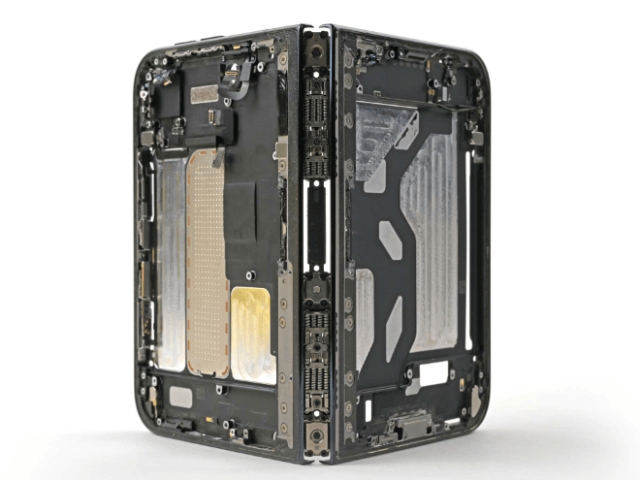
Apple’s first foldable, the iPhone Duo, has landed on the teardown table, and early owners are already reporting cracks and bright lines along the fold—sometimes within hours of unboxing or before setup finishes. Apple is swapping affected units for now, but out-of-warranty inner-screen damage runs $999. A detailed teardown from iFixit’s Elizabeth Chamberlain digs into the design, the clever crease-hiding tricks, the complex hinge, dust vulnerability, and why this is still the highest-scoring foldable for repairability the site has tested. Repairability Wins (Relatively Speaking) The Duo earns a provisional 5 out of 10 for repairability—the highest iFixit has given any foldable smartphone. Credit goes to familiar iPhone-style choices: batteries that release cleanly with electrically debonding adhesive (no aggressive prying needed), an outer screen and trim that come off intact, and a relatively flat disassembly path that reaches cameras, the modular USB-C port, and other parts without tearing the whole device apart. The batteries sit in metal shells (roughly 7.5 Wh and 11.6 Wh for a combined 19.1 Wh) and the logic board is a single-layer design, the first of its kind on a recent iPhone since the iPhone 8 era. That score is provisional pending full availability of replacement parts through Apple’s self-service program. Apple has published a repair manual on day one. Even so, Dent’s team is clear: this is not an endorsement of casually repairing the Duo. The inner folding screen remains the expensive, time-consuming weak point—delicate adhesive work that could take a typical DIYer several hours even with proper fixtures. Full inner-display replacement is the $999 job; a separate flexible polymer cover layer with the matte nano-texture can be swapped for far less ($49 without AppleCare, $19 with it). How Apple Tries to Hide the Crease No foldable has fully eliminated the crease, and the Duo is no exception despite marketing language calling it nearly “creaseless.” Under the microscope, the nano-texture finish looks like tightly packed rounded bumps (similar to bubble wrap). These scatter light and soften reflections, helping disguise the dip along the fold. Remove that cover layer and the crease becomes more obvious—arguably more visible than on a Galaxy Z Fold 8 in side-by-side comparison. The surface underneath also scratches more easily. Digging deeper, some red, green, and blue subpixels are oval and oriented at varying angles rather than in a regular grid. An Apple patent on reducing diffraction artifacts in polarizer-free displays describes exactly this kind of geometric dithering—dividing the display into regions with unique patterns and up to 32 displacements—so optical artifacts don’t reinforce one another and draw the eye to the fold. Gaps in the pixel pattern also accommodate the inner selfie camera (photos from it have been described as somewhat muddy). 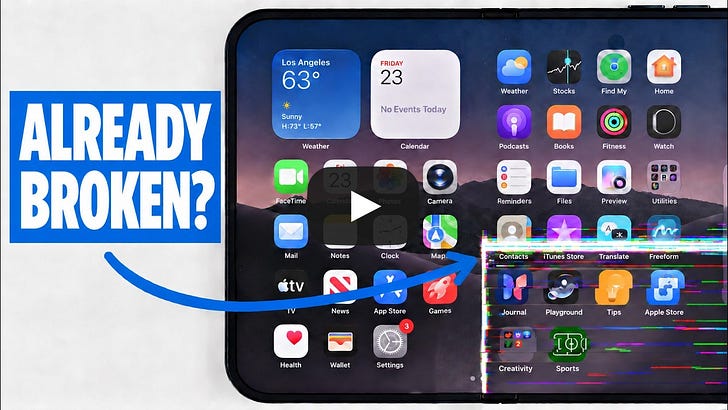
The Hinge, Dust, and Those Early Failures The hinge follows the familiar waterdrop approach used across modern foldables: the screen curves gently inside the mechanism rather than forming a sharp crease when closed. A chain of metal joints (likened to a watchband), springs, curved guides, and synchronization gears control the bend, reduce stretch/squeeze on the display layers, and help the phone hold intermediate positions. An accordion-style flex cable routes signals through a gap in the hinge. Apple’s patents describe more than ten ultrathin layers and adhesives designed to glide during folding. Glow-dust testing (finer than beach sand but representative of everyday grit) showed the IP68-rated Duo is better sealed than some competitors: fewer particles reached the internals or hinge than in prior Galaxy Z Fold 8 or Pixel foldable tests. Still, enough dust entered the hinge to produce a crunching sound. Dust also appeared in the USB-C port, speaker mesh, and bezel areas. Cleaning or servicing the hinge means removing the flexible display and supports. Reported screen failures often involve a pop or crunch during open/close, followed by a small line on the fold and bright lines across the display. Damage frequently clusters near the transition between the flex-cable gap and the central hinge support. Using teardown footage, patents, and CT scans, the team built a 3D model of the hinge. One hypothesis is that a center support bar fails to drop fully as the phone closes, creating a local stress hotspot where the curved display presses against it. A stuck center pivot or other nearby components could contribute. A localized electrical fault can black out an entire row or column of pixels even without obvious external damage. MacDailyNews Take: For a first-generation foldable, Apple incorporated meaningful repair-friendly elements that push the Duo ahead of prior foldables on iFixit’s scale. The electrically releasable batteries and accessible outer components are genuine improvements. Yet the inner screen and hinge remain expensive and labor-intensive to fix, early failure reports are clustering in a specific high-stress zone, and dust can still reach the mechanism. Conventional phones (or more repair-oriented devices like certain Fairphones) still score higher overall. Owners should consider AppleCare+ coverage and treat the folding screen carefully — especially around dust and repeated folding stress. In many cases Apple is currently replacing affected early iPhone Duo units free of charge under the standard one-year limited warranty. If yours is affected, document everything (photos, timing, lack of damage), take it to an Apple Store with the receipt/box if possible, and emphasize it happened under normal use. The situation is still evolving with the device only a few days old. The full teardown, images, video, microscope shots, and 3D hinge model are available on iFixit here. Support MacDailyNews at no extra cost to you by using this link to shop at Amazon. Like 
or dislike 
this post below! The post iFixit teardown: iPhone Duo is the most repairable foldable yet, but that $999 display fold problem is a bear appeared first on MacDailyNews. You're currently a free subscriber to MacDailyNews. For the full experience, upgrade your subscription.
|






No comments:
Post a Comment