
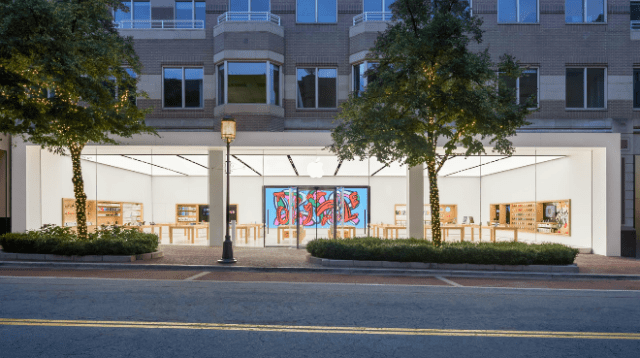
Apple has agreed to pay $150,000 to resolve claims by the U.S. Equal Employment Opportunity Commission (EEOC) that a manager at one of its retail stores made antisemitic remarks and denied a longtime Jewish employee’s requests for time off before terminating him. The settlement was disclosed in a joint filing Friday in federal court in Alexandria, Virginia. It comes nearly a year after the EEOC sued the company. According to the EEOC, the manager of the Apple store in Reston, Virginia, targeted Tyler Steele, an employee who began working there in 2007 as an “Apple Genius” providing technical support and advice to customers. Steele converted to Judaism in 2023. A new manager hired that year allegedly denied Steele’s requests to avoid working on Fridays and Saturdays in observance of the Jewish Sabbath, which runs from sundown Friday to sundown Saturday. The commission further alleged that the manager told Steele he smelled of body odor, required him to work on the Sabbath, and instructed him not to discuss the October 2023 Hamas attack on Israel with coworkers. Steele was fired in January 2024, a few days after he refused a request to work on a Friday, the EEOC said. The lawsuit accused Apple of religious discrimination and retaliation in violation of Title VII of the Civil Rights Act of 1964. The EEOC sought unspecified back pay and other damages for Steele, including punitive damages for what it described as “malicious and reckless conduct.” Apple denied any wrongdoing in its court filings. Neither the company nor the EEOC immediately responded to requests for comment. The case is EEOC v. Apple, U.S. District Court for the Eastern District of Virginia, No. 1:25-cv-01637. The EEOC routinely brings religious discrimination cases. Under Chair Andrea Lucas, who was appointed by President Donald Trump, the agency has placed renewed emphasis on the issue, securing more than $25 million in settlements since last year in a series of cases involving employers’ illegal COVID-19 vaccine mandates. MacDailyNews Take: Mazeltov! Now, to clarify, hiring a Jewish person in the U.S. does not automatically mean they are exempt from working on Fridays or Saturdays. Here’s how it actually works under federal law (Title VII of the Civil Rights Act of 1964): • Employers with 15 or more employees must provide a reasonable accommodation for an employee’s sincerely held religious beliefs or practices (which, of course, is basically unprovable; if they say they have sincerely held religious beliefs or practices, they basically do), unless doing so would impose an undue hardship on the business. • For some observant Jews, that includes not working during the Sabbath (Shabbat), which runs from sundown Friday to sundown Saturday. The same rule applies to other Sabbath-observing religions (e.g., some Christians who observe Sunday, Seventh-day Adventists, etc.). • The employee must actually request the accommodation based on their religious beliefs. Simply being Jewish does not create an automatic schedule exemption. Many Jewish people do not strictly observe the Sabbath and routinely work Fridays and Saturdays. Key points after the 2023 Supreme Court decision in Groff v. DeJoy • “Undue hardship” is no longer the old low bar of “more than a de minimis cost.” • The employer must now show that the accommodation would cause substantial increased costs in the overall context of its particular business. • Common accommodations include voluntary shift swaps, schedule changes, or other adjustments. Employers are expected to explore options. In a nutshell: Observant employees who request time off for the Sabbath or other beliefs or practices have stronger protections than before 2023, and employers cannot casually deny those requests. However, there is no blanket rule that every Jewish hire is automatically off Fridays and Saturdays. It depends on the individual’s sincere religious practice and whether a reasonable accommodation is possible without substantial hardship to the employer. For more information on religious discrimination, please visit https://www.eeoc.gov/religious-discrimination. For more information on retaliation, please visit https://www.eeoc.gov/retaliation. See also: Support MacDailyNews at no extra cost to you by using this link to shop at Amazon. The post Apple agrees to $150,000 settlement over EEOC claims of antisemitic discrimination by retail store manager appeared first on MacDailyNews. You're currently a free subscriber to MacDailyNews. For the full experience, upgrade your subscription.
|




No comments:
Post a Comment