
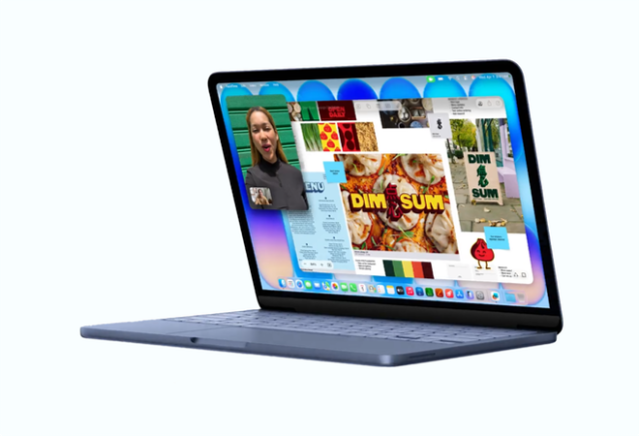
Apple is bringing touch to its premium laptops. According to a new report by Bloomberg News’ Mark Gurman, the company’s first-ever touchscreen MacBook — likely a high-end MacBook Pro model — will launch between late 2026 and early 2027, powered by the current-generation M5 Pro and M5 Max chips rather than a brand-new processor family. This marks a significant shift for Apple, which has long resisted touchscreen Macs under Steve Jobs’ philosophy that touch belongs on tablets. The new models will sit at the top of the lineup and introduce OLED displays with touch capabilities, while retaining the full keyboard and trackpad for traditional input. Why M5 Chips Now? The decision to use existing M5 Pro and M5 Max silicon (introduced earlier in 2026 with strong AI performance, faster SSDs, and up to 128GB unified memory on the Max) suggests Apple wants to accelerate the touchscreen debut without waiting for the next chip generation. These chips already deliver excellent performance for pro workloads, AI tasks, and battery efficiency—up to 24 hours in current MacBook Pros. An M7 Pro and M7 Max refresh is already in the works, expected as early as the end of 2027. This rapid cadence indicates Apple plans to iterate quickly on the new touchscreen platform. What to Expect from the Touch MacBook • Display: OLED panel (a big upgrade from mini-LED) with touchscreen support, Dynamic Island-style notch, and a hole-punch camera. macOS will likely gain touch-optimized controls. • Design: Thinner and lighter chassis. • Positioning: Premium “high-end MacBook” (possibly even a “MacBook Ultra” in some rumors), complementing rather than replacing standard MacBook Pros. • Timeline: Initial M5-powered versions late 2026/early 2027, followed by M7 models. This launch comes after the M5 Pro/Max MacBook Pros released in spring 2026, meaning Apple is delivering two major Pro updates in one year—a sign of aggressive competition in the AI laptop space. Why This Matters For years, Windows laptops (and some Chromebooks) have offered touch and 2-in-1 designs, while Apple kept the iPad as its touch device. A touchscreen MacBook could blur those lines, appealing to creatives who want stylus support, developers who prefer direct manipulation, or users who simply enjoy the flexibility of both touch and precision input. However, success isn’t guaranteed. Apple will need to nail macOS touch integration to avoid a “Touch Bar 2.0” situation. Early indications point to a hybrid approach: touch as an additional input method, not a replacement for the trackpad and keyboard. This all fits into Apple’s broader 2026–2027 hardware push: AI-optimized chips, OLED across more devices, and new form factors like potential foldables. The touchscreen MacBook represents one of the most significant, if reactionary, design changes for the Mac in over a decade. Nobody touches our MacBook Pro displays, not even us! We’re perfectly fine with using mice and trackpads, so we’ll continue to keep our Mac displays free of greasy fingerprints, even if we end up with touchscreen-capable Macs. Who really wants to smear their fingers all over their MacBook Pro’s display? Seems like a gimmick for ignoramus Windows PC sufferers. Touch surfaces don’t want to be vertical. After an extended period of time, your arm wants to fall off. – Steve Jobs For many years, every MacBook Pro has offered a built-in multi-touch-capable Force Touch trackpad. Does it make more sense to be smearing your fingers around on your notebook’s screen or on a spacious trackpad that’s designed specifically and solely to be touched? … The iPhone’s screen has to be touched; that’s all it has available. A MacBook’s screen does not have to be touched in order to offer Multi-Touch. — MacDailyNews, March 26, 2009 I think anything can be forced to converge. The problem is that products are about tradeoffs, and you begin to make tradeoffs to the point where what you have left at the end of the day doesn’t please anyone. You can converge a toaster and a refrigerator, but those things are probably not going to be pleasing to the user. – Apple CEO Tim Cook, remarking on the idea of a converged Mac and iPad, April 25, 2012 We really feel that the ergonomics of using a Mac are that your hands are rested on a surface, and that lifting your arm up to poke a screen is a pretty fatiguing thing to do. I don’t think we’ve looked at any of the other guys to date and said, how fast can we get there? — Apple SVP Craig Federighi, June 5, 2018 [Y]ou get this in-between thing, and in-between things are never as good as the individual things themselves. We believe the best personal computer is a Mac, and we want to keep going down that path. And we think the best tablet computing device is an iPad, and we’ll go down that path. iPad benefits because we assume that you need to be able to do most everything with touch, and we don’t have to trade off on that experience. Mac assumes you want to do most everything with a keyboard and mouse input. We don’t have to trade off on that path. You can look at some of the other products that will try to go halfway between the two. They end up just compromising experiences. That’s not good. – Apple SVP Phil Schiller, November 13, 2019 Support MacDailyNews at no extra cost to you by using this link to shop at Amazon. The post Apple’s touchscreen MacBook to sport M5 Pro and M5 Max, with M7 models to follow appeared first on MacDailyNews. You're currently a free subscriber to MacDailyNews. For the full experience, upgrade your subscription.
|




No comments:
Post a Comment