Steve Jobs and Steve Wozniak signed 1976 Apple Computer check No.1 sells for $2.4 million
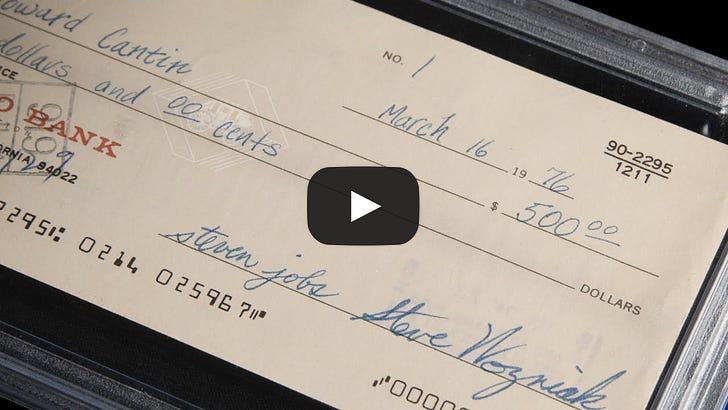
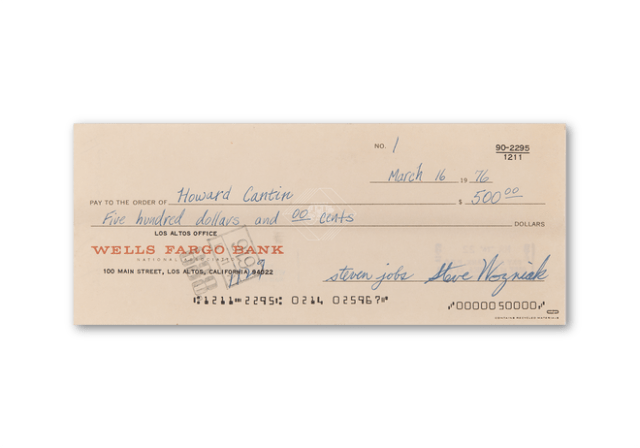
A Wells Fargo bank check, 7.5 x 3, filled out and signed by Steve Jobs, “steven jobs,” and countersigned by Steve Wozniak, “Steve Wozniak,” payable to Howard Cantin for $500, dated March 16, 1976, has sold at auction for $2,409,886.
Steve Jobs and Steve Wozniak signed 1976 Apple Computer check No.1
A Wells Fargo bank check, 7.5 x 3, filled out and signed by Steve Jobs, “steven jobs,” and countersigned by Steve Wozniak, “Steve Wozniak,” payable to Howard Cantin for $500, dated March 16, 1976, has sold at auction for $2,409,886.
This temporary check, issued upon opening Apple’s first bank account, bears the same routing and account numbers as the other early Apple Computer Company checks we have offered; remarkably, this was the very first check to be drawn on the account, paying Howard Cantin for his services as the designer of the Apple-1 printed circuit board (PCB). The later checks carrying this account number were imprinted with Apple’s first official address at ‘770 Welch Rd., Ste. 154, Palo Alto’ — the location of an answering service and mail drop that they used while still operating out of the famous Jobs family garage.
Marked as check “No. 1,” this historically important check pre-dates the official founding of Apple Computer, Inc.—some sixteen days later, on April 1, 1976, co-founders Steve Jobs, Steve Wozniak, and Ronald Wayne would sign the partnership agreement that officially brought Apple Computer into existence. The agreement assigned 45% of the company to each of the Steves, and 10% to Wayne. It also required any expenditure over $100 to be approved by two of the partners—perhaps the reason that both Jobs and Woz signed this check.
During this early period, Jobs and Woz envisioned the Apple-1 as a bare-board kit to be soldered together by hobbyist users—their initial target market, Silicon Valley’s Homebrew Computer Club. As the two were effectively penniless, Jobs sold his beloved Volkswagen Bus and Woz sold his prized HP-65 pocket calculator to raise the initial working capital to fund the Apple Computer Company. In his autobiography iWoz, Wozniak recounts: “To come up with the $1,000 we thought we’d need to build ready-made printed circuit boards, I sold my HP 65 calculator for $500. The guy who bought it only paid me half, though, and never paid me the rest… And Steve sold his VW van for another few hundred dollars. He figured he could ride around on his bicycle if he had to. That was it. We were in business.”
These early sacrifices are witnessed in Apple Computer’s first bank statement, offered in this sale as Lot #6002, which shows that their very first deposit — a mere $500 — came on the same day that they wrote this check. It also documents the $500 deduction from the account on March 23rd, matching the Wells Fargo stamp on the check’s reverse.
Howard Cantin was the printed-circuit-board (PCB) layout engineer who translated Apple?1 designer Steve Wozniak’s schematic into the actual board that became the first product of Apple Computer Company in 1976. At the time, Cantin was working for Atari, Inc. and had experience doing PCB layouts for early Atari machines; Wozniak tapped him because he trusted Cantin’s craftsmanship for the delicate job of laying traces, component placement, and routing on a board intended for manufacture in small numbers.
Cantin’s involvement was crucial: although Wozniak’s design defined the logic, the aesthetics and manufacturability of the Apple-1 board depended on Cantin’s layout work. The board that Cantin laid out in 1976 used manual techniques (tape for trace routing) and helped form the physical foundation of what became one of the most celebrated early personal computers.
This inaugural Apple check thus stands as an extraordinary artifact from the very moment theory became product—when a visionary schematic, a garage workshop, and a fledgling partnership crossed the threshold into an operating business. Bearing the signatures of co-founders Jobs and Woz and issued to the craftsman who physically realized the Apple-1, it encapsulates the collaborative ingenuity and scrappy resourcefulness that defined Apple’s genesis. As the first financial instrument ever drawn on the Apple Computer Company’s original account, it is the foundational document that financed the creation of Apple’s very first product and brought forth the personal computing revolution.
MacDailyNews Take: Imagine getting a check for $500 (the equivalent in purchasing power to approximately $2,900 today) that in 50 years would be worth $2,409,886!
By the way, if Cantin saved that $500 and invested it on the day of Apple’s IPO on December 12, 1980, that investment now would be worth about approximately $1.32 million.
Please help support MacDailyNews — and enjoy subscriber-only articles, comments, chat, and more — by subscribing to our Substack: macdailynews.substack.com. Thank you!




No comments:
Post a Comment