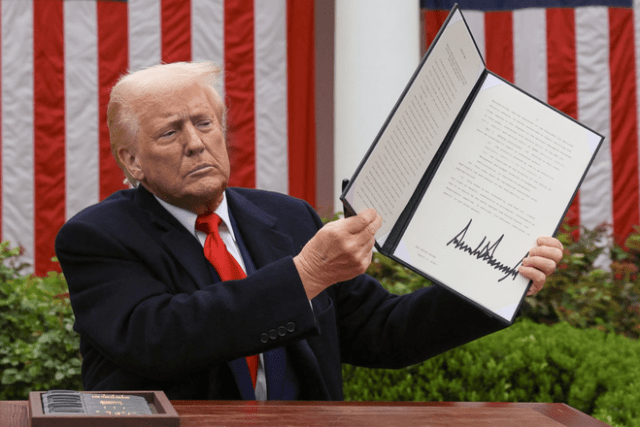
President Donald Trump holds a signed executive order on tariffs, in the Rose Garden at the White House in Washington, D.C., April 2, 2025. Photo by Leah Millis/Reuters
Following the U.S. Supreme Court’s decision to invalidate President Donald Trump’s broad import tariffs imposed under the International Emergency Economic Powers Act (IEEPA), the president vowed to pursue alternative measures to maintain the import duties he views as critical to his economic and foreign policy goals.
On Friday, Trump announced plans to introduce a flat 10% tariff on imports from foreign countries in the near term. He also stated that he would launch multiple trade investigations, which could pave the way for implementing much more enduring tariffs.
The president has credited his tariff regime for driving substantial investments in the U.S. and preventing foreign conflicts.
“The Supreme Court did not overrule tariffs, they merely overruled a particular use of IEEPA tariffs,” Trump told reporters, referencing the emergency authorities that the high court found illegal. “Now I’m going to go in a different direction, probably the direction that I should have gone the first time.”
Trump said he would pursue the baseline duty under Section 122 of the Trade Act of 1974, which grants the president unilateral ability to impose tariffs. But the untested legal provision puts a 150-day limit on how long the duties can remain in place. Trump said he expected the new baseline rate to go into effect “three days from now.”
A White House official later said that the 10% rate would apply to all countries with trade agreements while new tariff authorities are worked out.
Bond yields pared an earlier advance and stocks extended gains after Trump announced the plan for a 10% duty…
Trump also said existing tariffs under Section 301 and Section 232 would remain in place and vowed to launch additional investigations. The president has previously used those measures to levy Chinese exports, automobiles and metals. He suggested that those investigations could be carried out while the 10% baseline was in place, and eventually replace the flate rate — though he declined to rule out whether he might also seek an extension of the Section 122 levies. Trump said he was eyeing tariffs on foreign cars ranging from 15% to 30%.
The president’s plan to impose a 10% global duty could lift the average US effective tariff rate to 16.5% from 13.6%, or lower it to 11.4% if current exemptions are maintained, Bloomberg Economics estimated…
“Foreign countries that have been ripping us off for years are ecstatic. They’re so happy, and they’re dancing in the streets — but they won’t be dancing for long,” Trump said.
Treasury Secretary Scott Bessent said that revenue collected from tariffs will be “virtually unchanged” in 2026, despite Friday’s Supreme Court ruling, as President Donald Trump uses alternate authorities to impose duties.
“This administration will invoke alternative legal authorities to replace the IEEPA tariffs,” Bessent said…
Bessent said that the Trump administration will use other mechanisms to replace the measures, including authorities granted by Congress known as Section 122, 232 and 301 authorities.
“Treasury’s estimates show that the use of Section 122 authority, combined with potentially enhanced Section 232 and Section 301 tariffs will result in virtually unchanged tariff revenue in 2026,” he said in prepared remarks to the Economic Club of Dallas. Answering questions after the speech, he underscored, that “no one should expect that the tariff revenue will go down.”
Please help support MacDailyNews — and enjoy subscriber-only articles, comments, chat, and more — by subscribing to our Substack: macdailynews.substack.com. Thank you!




No comments:
Post a Comment